MYTH.
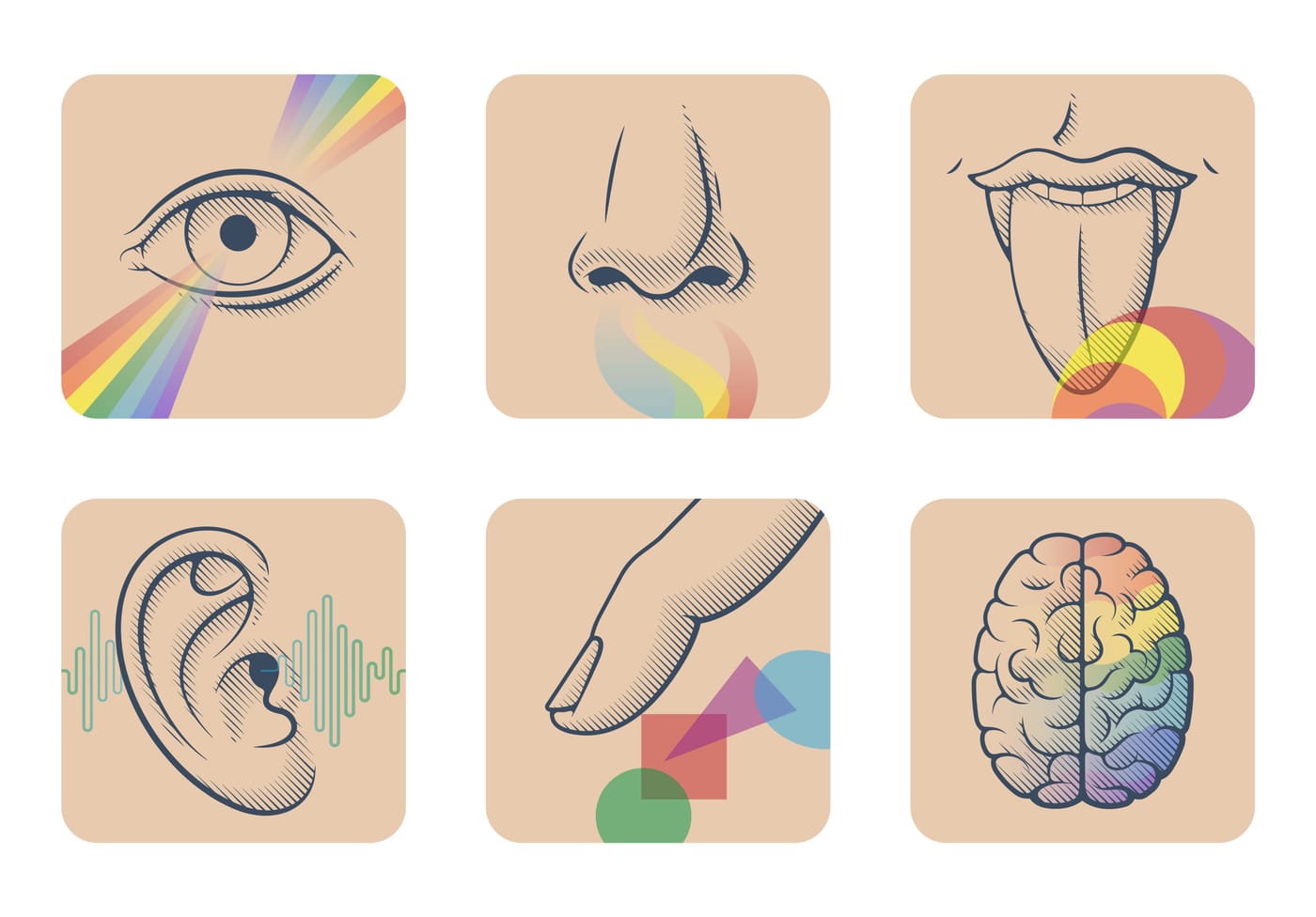
The five senses — sight, hearing, smell, taste, touch — are one of the first things taught in school, one of the most repeated facts in everyday life, and one of the more significant undersells in the history of human biology. The number five dates back to Aristotle, who catalogued the senses in the 4th century BC with the tools available to him at the time. Modern neuroscience has since added considerably to the list.
The most commonly cited additions are proprioception and the vestibular sense. Proprioception is your body's awareness of its own position in space — the reason you can touch your finger to your nose with your eyes closed, or type without looking at the keyboard. Big Think notes it operates through receptors in your muscles called spindles, which continuously relay position data to the brain. The vestibular sense, housed in the inner ear, tracks balance, motion, and spatial orientation — it's what gets disrupted when you spin too fast and why alcohol impairs coordination before it impairs sight.
Beyond those two, scientists have identified thermoception (temperature), nociception (pain as distinct from touch), interoception (internal body signals like hunger, heart rate, and thirst), and chronoception (the sense of time passing). Depending on how finely researchers define the boundaries, the count runs anywhere from 9 to 33 distinct human senses. A 2026 study published in Science Daily put the figure at potentially 33, noting that what we call "touch" alone encompasses pain, temperature, itch, and several tactile sub-categories.
Science Insights points out that the disagreement isn't about whether these extra senses exist — it's about how finely you want to slice the categories. Every sense on the extended list has its own distinct receptors and neural pathways, which is the standard scientific criterion for counting something as separate.
Aristotle got the concept right. He just didn't have enough senses to count all of them.















