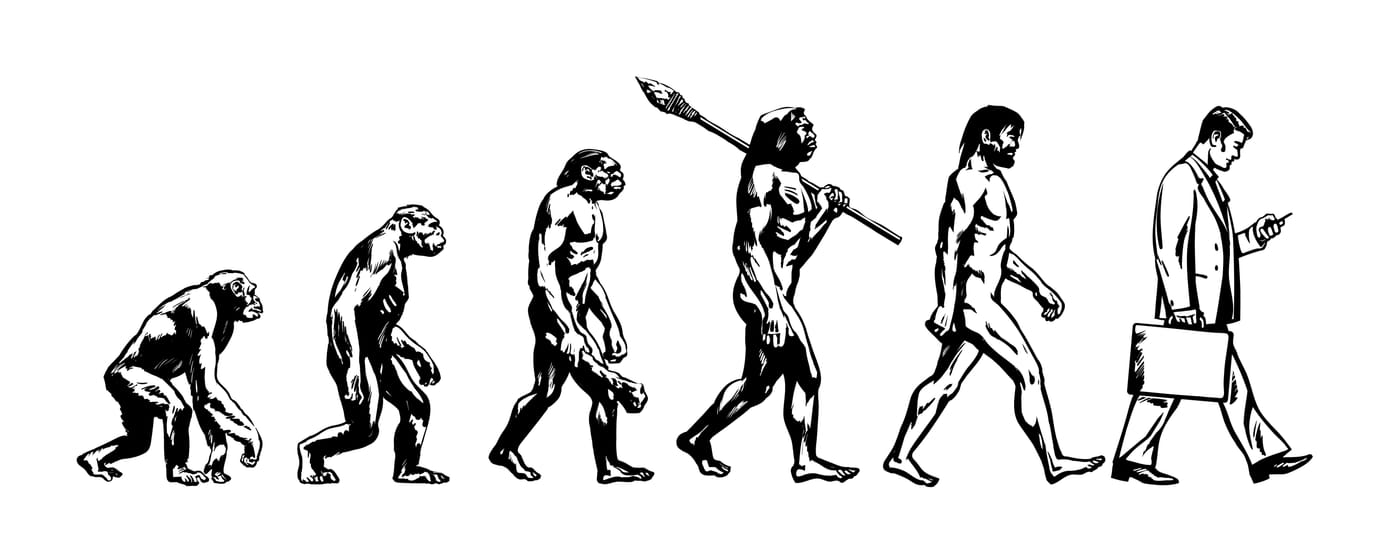
MYTH.
Humans did not evolve from chimpanzees. This is one of the most persistent misunderstandings of evolutionary theory, and it is also the single most common argument used against it. The reasoning goes: if humans evolved from chimps, why are there still chimps? The answer is that the premise is wrong. Humans and chimpanzees didn't have a parent-child relationship. They had a shared grandparent.
Between 6 and 7 million years ago, a now-extinct common ancestor gave rise to two separate lineages that would eventually become modern humans and modern chimpanzees. The Smithsonian's Human Origins Program explains that both species evolved from that ancestor along diverging paths — one toward bipedalism, complex language, and tool use at scale; the other toward the forest-dwelling, highly social primates that exist today. Neither species is descended from the other. They are, in the most meaningful biological sense, cousins who haven't seen each other in six million years.
Modern chimpanzees have been around longer than modern humans. Homo sapiens emerged roughly 300,000 years ago; chimpanzees as a species predate us by considerably more. The idea that chimps are a primitive version of us waiting to finish evolving gets the relationship exactly backwards. Chimpanzees are not incomplete humans. They are a separate and fully realized species that has been successfully occupying its ecological niche for millions of years.
The confusion is partly linguistic. HowStuffWorks notes that phrases like "humans evolved from apes" are technically accurate in one sense — our lineage passed through ancestral ape-like species — but are routinely misread as meaning humans descended from the living apes we can see today at a zoo.
We share roughly 98% of our DNA with chimpanzees. We are not their descendants. We are their extremely distant relatives, which is somehow even stranger.















