TRUTH.
On Earth, a bullet's story is brief. Fire a gun horizontally and gravity bends its path to the ground within half a second. Even fired straight up, a typical bullet returns to Earth in under a minute. The atmosphere slows it, gravity pulls it, and it stops. In space, none of those forces apply — and the consequences are genuinely strange.
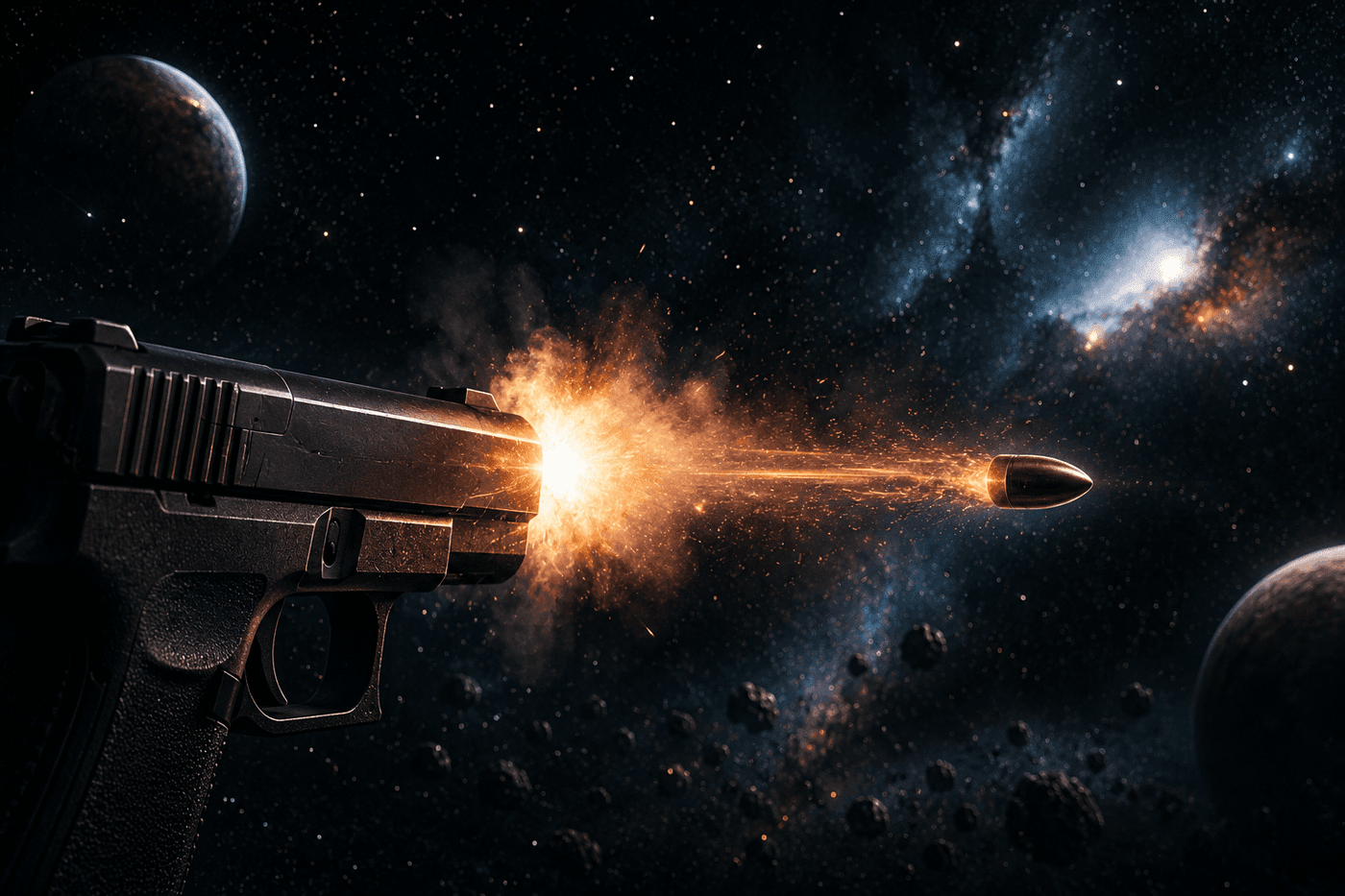
First, the gun would fire at all. Modern ammunition is self-contained: each cartridge carries its own primer, propellant, and oxidizer. No atmospheric oxygen required. Pulling the trigger in the vacuum of space produces the same chemical reaction it does on Earth — just in silence, since sound needs a medium to travel through and space provides none. The bullet leaves the barrel at the same velocity it would here.
What happens next is where physics takes over. With no air resistance and no meaningful gravitational pull in open space, the bullet experiences no deceleration. Newton's first law — an object in motion stays in motion unless acted on by an external force — applies without exception. The bullet keeps moving at the same speed, in the same direction, indefinitely.
And because the universe is expanding faster than the bullet can travel, it will never encounter enough matter to be stopped. Matter roughly 40,000 to 50,000 light-years away is already receding faster than the bullet moves. The bullet becomes, in effect, a tiny permanent piece of space debris — an eternal traveler that will outlast every star currently burning in the sky.
One footnote worth noting: the shooter would also drift backward forever, pushed by the same recoil that sent the bullet forward. Newton's third law doesn't take days off in space either.















