
In the 1970s, the average house fire gave occupants roughly 17 minutes to escape once smoke was detected. Today, that window has collapsed to somewhere between three and four minutes — in some cases less. The reason is the homes themselves. Modern houses are full of synthetic materials — foam furniture, plastic fixtures, composite building products — that ignite faster, burn hotter, and produce toxic gases far more quickly than the wood and cotton that furnished homes a generation ago.
The fire hasn't changed. The environment around it has. And most people's mental model of how much time they have in an emergency is still calibrated to a world that no longer exists.
17 Minutes to 3: How Modern Homes Changed the Math
The shift is documented by the UL Firefighter Safety Research Institute, which has spent years studying how fires behave in contemporary residential structures. Their findings reframed what firefighters thought they understood about escape time and shifted how fire safety advocates think about survivability.
The core problem is that when synthetic materials ignite, they create a cascading burn that is faster, hotter, and harder to outrun than older combustion models predicted. A fire that would have given a 1970s family 17 minutes now gives a 2026 family a fraction of that time — often not enough to get everyone out, orient to an unfamiliar escape route, or wait for a sleeping family member to wake up.
What Happens to a Room With an Open Door
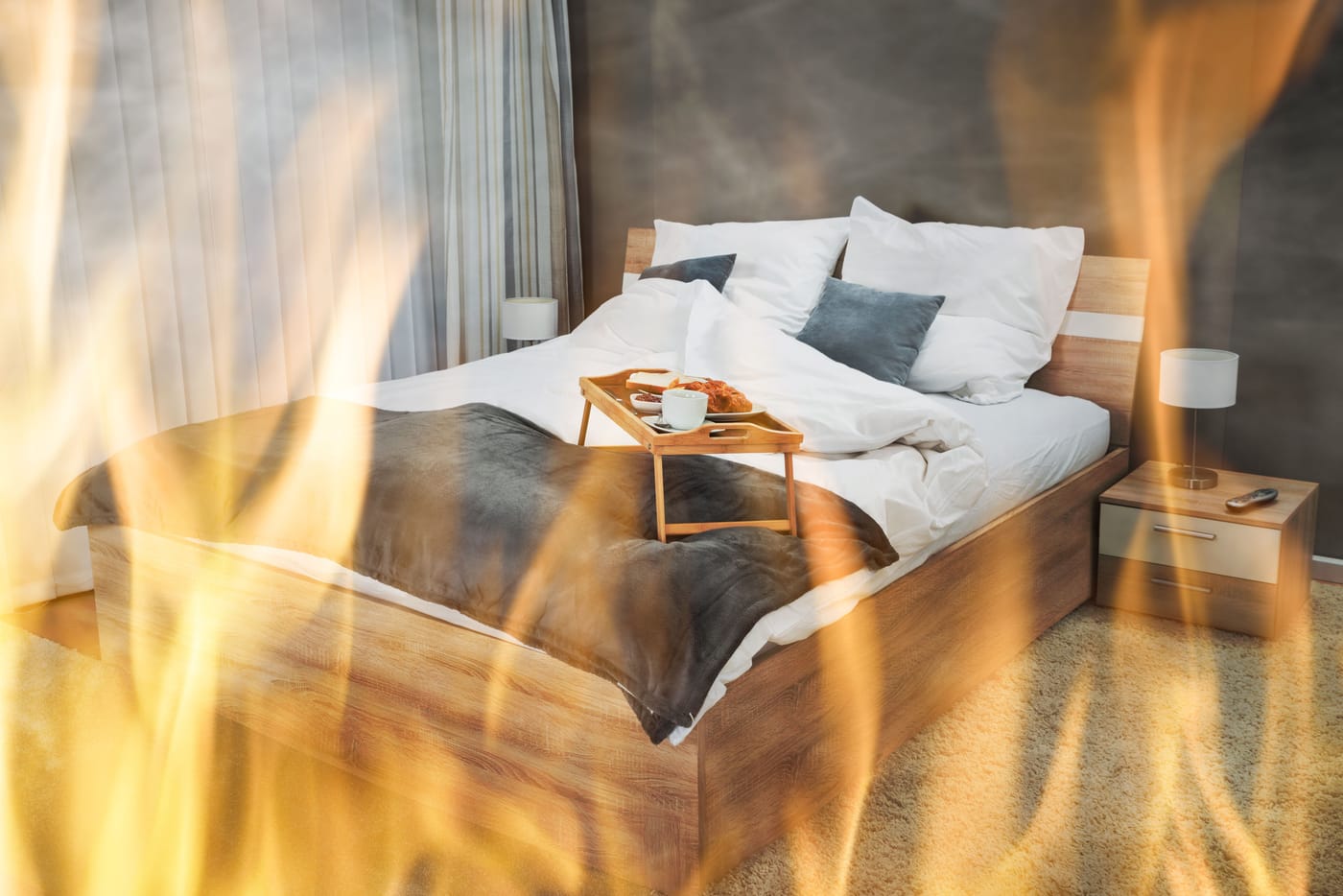
Research by UL FSRI, conducted as part of their Close Before You Doze campaign, measured what actually happens to two adjacent rooms during a fire when one door is open and one is closed.
The numbers are stark. In a room with an open door during an active fire, temperatures can exceed 1,000°F. Carbon monoxide levels can reach 10,000 parts per million — a concentration that causes loss of consciousness within minutes. In the room with the closed door, temperatures stayed below 100°F. Carbon monoxide levels stayed at approximately 100 parts per million — survivable, breathable air.
The door in those tests was not a heavy fire door or a reinforced barrier — it was a standard hollow-core interior door of the kind installed in the vast majority of American homes. The door doesn't stop a fire. It delays it, and that delay is what survivability looks like in a modern house fire.
60% Are Getting This Wrong Tonight
The UL FSRI data suggests that approximately 60% of Americans sleep with their bedroom door open. The reasons are typically comfort-related — better airflow, ability to hear children or pets, personal preference — none of which are unreasonable in ordinary circumstances.
What most people don't know is that closing the door at night is one of the single highest-impact changes they can make to their odds of surviving a house fire. It costs nothing. It requires no equipment. It works with the cheapest interior door on the market.
Survivability in a modern house fire depends almost entirely on time — time before temperatures become unsurvivable, time before CO levels cause loss of consciousness, time before a fire reaches the room. A closed door buys that time in ways that smoke detectors alone cannot.
One Change Tonight
The smoke alarm wakes you up. The closed door gives you the minutes to respond. Both matter, and neither is useful without the other.
NFPA data on residential fires consistently shows that the majority of fire deaths occur in the bedroom — usually due to smoke inhalation during sleep, before the occupant has a chance to wake and exit. A closed door is not a guarantee, but it is the simplest structural change between you and that outcome.
Close it before you sleep tonight. The adjustment takes two seconds. The reason to make it is the gap between 17 minutes and 3.














