
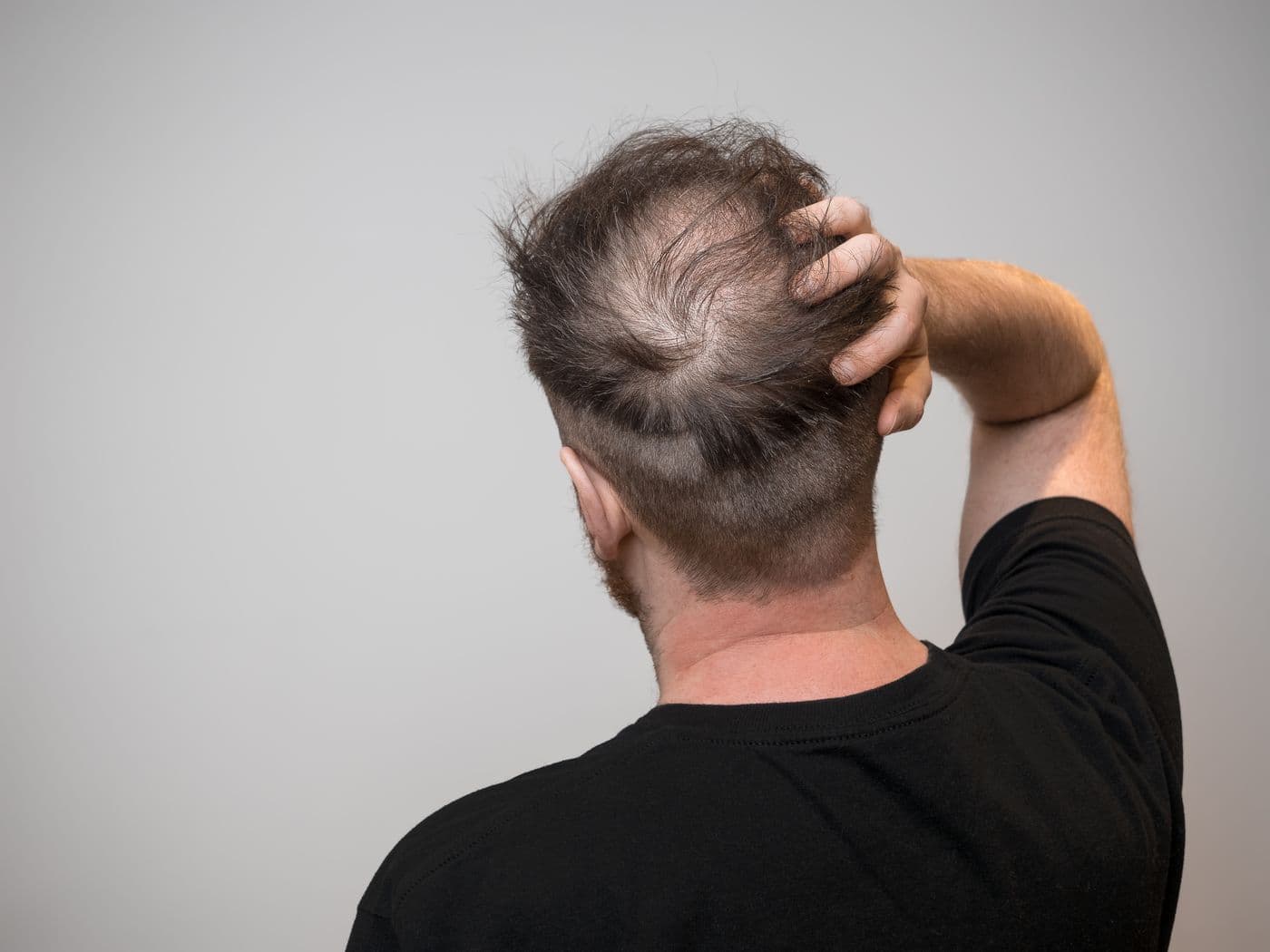
There is a detail in the research on baldness and health that most people don't know — and that changes the picture considerably.
Whether you're going bald doesn't tell you much. Where you're going bald might.
A 2013 meta-analysis published in BMJ Open pooled six studies covering nearly 37,000 men and found that hair loss at the crown of the head — the vertex, the flat area on top — was consistently associated with a raised risk of coronary heart disease. A receding hairline at the front, the temples pushing back, the widow's peak widening: essentially no raised risk at all.
The same hair, different location, completely different health signal.
The Numbers That Make This Specific
The association scaled with severity in a way that made researchers take it seriously. Men with mild vertex baldness had approximately 18% higher risk of coronary heart disease than men without hair loss. Moderate vertex baldness pushed that to 36%. Severe balding on top: 48%.
That dose-response — more hair lost on top, more risk — is part of what distinguishes this from statistical noise. A further analysis by epidemiologist Dr. Guy Eslick, pooling more than 29,000 men, found baldness associated with raised risk of coronary heart disease alongside insulin resistance and metabolic syndrome, both several times more common in balding men.
The prostate belongs on this list too. A 2025 review examining decades of studies found male pattern baldness appearing alongside higher risk of aggressive prostate cancer and benign prostate enlargement.
It's worth being honest about the mixed evidence. A large German cohort study found only a weak association between male pattern baldness and heart disease risk factors. The science is not settled, and a bald spot on top is not a diagnosis. But the association has appeared in enough independent large studies that researchers are taking it seriously rather than dismissing it.
Why Losing Hair on Top Is Different From Losing It at the Front

To understand why location matters, you need to understand what male pattern baldness actually is.
Going bald doesn't mean your hair follicles have died. "The actual factories that make the hair are not typically lost," explains Professor Desmond Tobin, professor of dermatological science at University College Dublin. "They're just miniaturised, such that the fibres they produce are so cosmetically invisible that they appear to be gone."
The culprit driving this miniaturisation is a hormone called dihydrotestosterone, or DHT — a potent derivative of testosterone. The key insight is that baldness isn't about having more testosterone. It's about how sensitive your tissues are to DHT.
"A man with a full head of hair won't necessarily have a lower amount of testosterone," Tobin explains. "It's just that their tissues are less responsive to that same level."
Here is why this connects to the rest of the body: DHT doesn't only act on hair follicles. It's "wired into tissues all over the body," as Tobin puts it. The same hormonal sensitivity that makes a man's crown follicles miniaturise may also be influencing cardiovascular tissue, prostate tissue, and metabolic function.
Baldness doesn't cause heart disease. Both may be symptoms of the same underlying hormonal wiring — which is also why the associations aren't perfect, and why plenty of bald men are in excellent cardiovascular health.
The Finasteride Connection Nobody Talks About
One of the stranger threads in this story involves finasteride — the most widely used baldness medication. It was never designed as a hair loss treatment.
"It was discovered by accident," Tobin says. "They were giving the drug to men who had enlarged prostates in their 60s — driven by androgens — and found that, as well as shrinking the prostate, it also helped hair regrowth."
A 2024 study from the University of Illinois then found that men taking finasteride had lower cholesterol levels than those who did not, and that the drug slowed the progression of fatty plaque buildup in the arteries of mice. The human sample was small and needs replication, but the implication is striking: a drug for baldness might also be tugging on the cardiovascular thread.
What to Actually Do With This

If you're now surreptitiously touching the top of your head, the researchers' advice is deliberate: don't panic, but pay attention.
The associations between vertex baldness and cardiovascular risk are real but modest. A bald patch on top doesn't predict a heart attack. What it may do, according to Tobin, is add urgency to the advice most people receive regardless of their hair status: eat less saturated fat, get more exercise, don't smoke, sleep better.
"If you let people know that early and extensive balders may have a higher association with cardiovascular disease, that could be significantly improved in terms of their longevity and health span if they adopted more heart-healthy practices," he says.
Your hairline was never the point. What matters is the health underneath it.