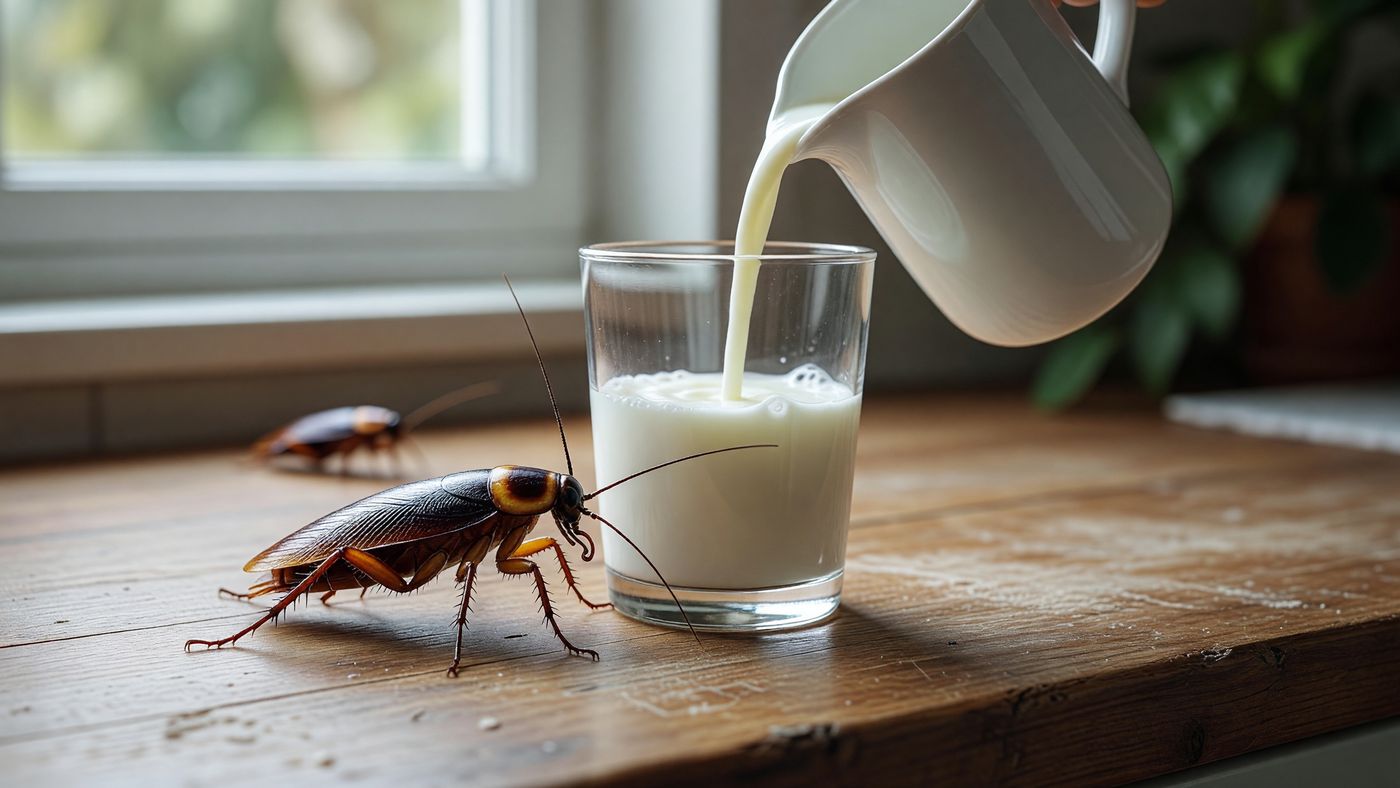
Every year, the Ig Nobel Prizes honor scientific research that "first makes people laugh, and then makes them think." The 2026 winner of the Chemistry prize is exactly that.
Scientists discovered that the Pacific beetle cockroach — Diploptera punctata, a species that gives birth to live young instead of laying eggs — produces a nutritionally dense crystalline "milk" to feed its embryos inside something called a brood sac, which is the insect equivalent of a uterus.
When researchers compared the energy content of this cockroach milk to cow's milk, they found it contains more than three times the energy per equivalent amount.
Scientists are now trying to figure out if it could be a future food source for humans. The Ig Nobel committee gave them a prize for it. The world is a strange and wonderful place.
Why a Cockroach Makes Milk in the First Place
Diploptera punctata is unusual in the insect world. Most cockroaches lay eggs and leave. This species keeps its young inside its body during development, which means the embryos need to be fed — and the mother has evolved a way to do exactly that.
She secretes a liquid milk directly into her brood sac, where the embryos consume it. Once consumed, the liquid doesn't just digest — it concentrates inside the embryo's gut and forms tiny, solid protein crystals. Those crystals function as a slow-release nutrient cache, delivering steady, protein-rich nourishment to the developing cockroach as it grows.
The researchers, looking at isolated crystals from cockroach embryo guts, found that a single cockroach milk crystal contains more than three times the energy of an equivalent amount of dairy cow's milk. The crystals are heterogeneous — varying in protein, carbohydrate, and lipid composition — which suggests they can provide a complete, adjustable nutrient profile as needed.
Cockroach milk, in short, is extraordinarily efficient food. Which is either inspiring or deeply unsettling depending on your relationship with cockroaches.
The Prize That Celebrates Exactly This Kind of Research

The Ig Nobel Prizes are awarded annually by the journal Annals of Improbable Research. Previous winners have included research on why shower curtains billow inward, whether cats are liquid, and the effect of opera music on cheese aging. The prizes are accepted — often with genuine enthusiasm — by real scientists who understand that being interesting and being rigorous are not mutually exclusive.
This year's ceremony took place in Switzerland on September 3, 2026 — a departure from the traditional Harvard venue. The theme was "fungi," which made the cockroach milk winner a notable outlier.
The original research that won the prize was published in 2016 in IUCrJ, the journal of the International Union of Crystallography. It took a decade for the work to get the recognition it apparently deserved.
Could Humans Actually Drink Cockroach Milk
This is the question everyone has, and the answer is: not yet, and probably not the way you're imagining it.
You cannot milk a cockroach. The "milk" exists inside the embryo's gut, not in any accessible location on the insect's body. Extracting it at scale would be impractical to the point of absurdity — you would need an enormous number of cockroach embryos to produce a meaningful amount.
What researchers have been exploring is whether the protein crystals could be synthesized artificially — produced in a lab using the cockroach's biological blueprint without requiring actual cockroaches. If the protein structure can be recreated synthetically, the energy density of cockroach milk becomes potentially useful as a food supplement or protein source, particularly for populations with high caloric needs.
That research is ongoing. Whether cockroach milk protein ends up in a protein bar near you is a question for a future decade. For now, it has an Ig Nobel Prize and a devoted international research team.
The cockroach has been on Earth for approximately 350 million years. It turns out it was also doing something useful the whole time.