Taylor Swift and Travis Kelce got married at Madison Square Garden on July 3. One thousand guests. No cell phones. A man-made pond under the altar. A 35-foot greenhouse structure. A carousel. Rows of real and fake trees. Custom monogrammed everything. A castle for the reception.
It reportedly cost $30 million.
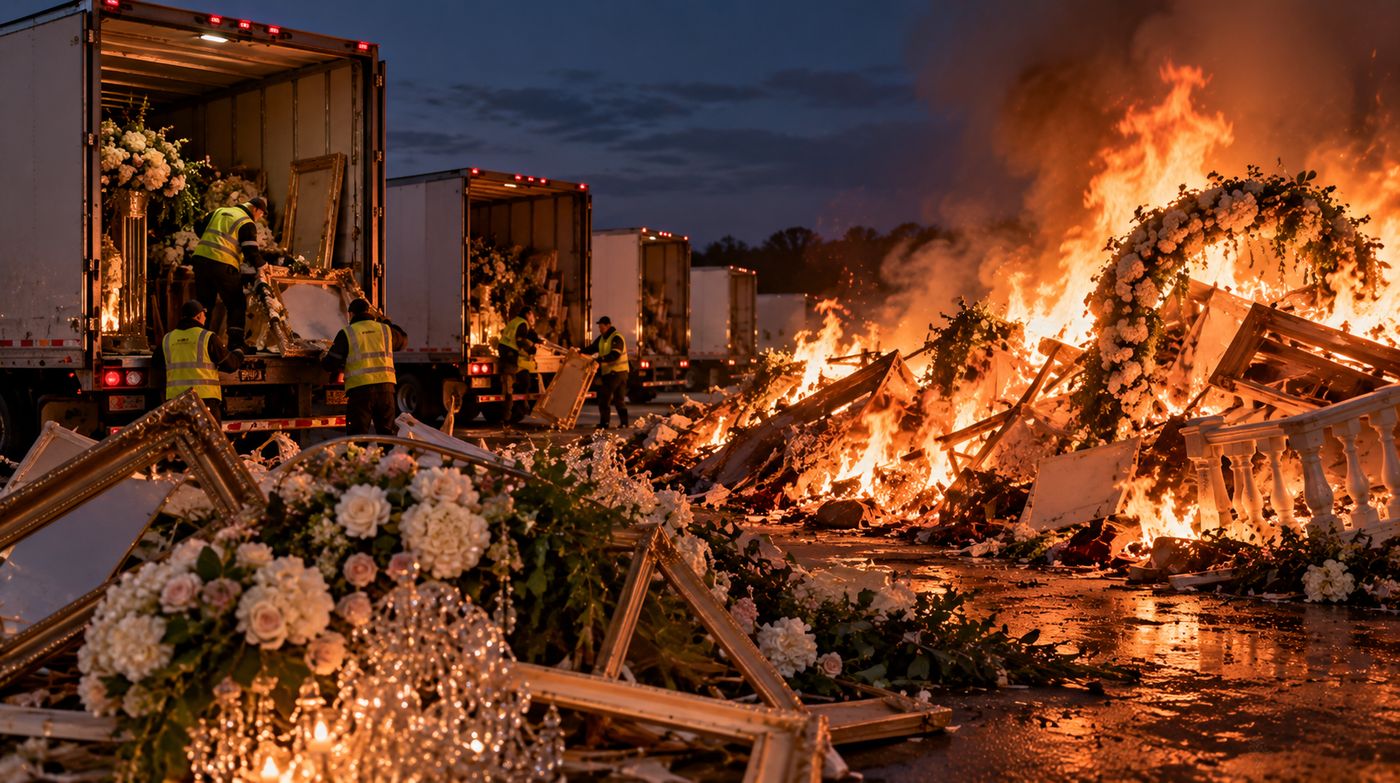
When it was over, 11 semi-trucks showed up. They loaded every piece of custom decor — the florals alone were estimated at $5 million — and drove it to Pennsylvania.
Then they burned it.
"They didn't want people to steal it and then auction it or sell it so they just burned it all," a source told the Daily Mail. "The fact that no one has relics of it and it all had to get burned and properly disposed of is kind of crazy."
Even the source who described it called it kind of crazy.
The Wedding Itself
Swift and Kelce transformed Madison Square Garden into what multiple eyewitnesses described as an enchanted forest. The production included custom Colosseum-like walls, fabric printed with forest graphics, a two-tiered carousel, a man-made pond positioned directly beneath the altar, and a peach-colored tent for lawn games.
A separate "castle" structure served as the reception space, where 10 food stations and multiple bars were set up throughout. Multiple camera crews filmed the entire event — sources described being on set for a movie rather than attending a wedding. Kelce called it "the best night of my life."
No guest was permitted to bring a phone or camera. Swift had specifically insisted on designing the ceremony herself rather than being handed a finished product — she didn't "want to just be handed a wedding," according to the Daily Mail.
Eleven semi-trucks transported the settings from the West Coast to the East Coast for the event. The same 11 trucks hauled the remains to Pennsylvania after.
The $30 Million Question
For context: the average American wedding in 2026 costs approximately $34,000, according to The Knot's Real Weddings Study. Swift and Kelce's wedding reportedly cost $30 million — nearly 900 times the national average.
The floral arrangements alone were estimated at $5 million. The venue transformation — converting an arena into a functioning enchanted forest — was estimated between $5 and $10 million. Catering for 1,000 guests across 10 food stations ran an estimated $2.5 to $3 million. Custom Dior looks for the couple, plus entertainment, added another $2 million.
And then there's the disposal. The decor was custom-built specifically for the wedding, which means it couldn't simply be resold through normal channels. But it also could have been donated, auctioned for charity, or repurposed. The decision to destroy it instead — specifically to prevent it from ever appearing at auction — is the detail that has generated the strongest reaction.
Why They Did It
The reasoning, per sources familiar with the decision, was straightforward: control.
Swift is one of the most intensively documented celebrities on the planet. Her team operates with a security and privacy apparatus that most public figures don't approach. A single piece of monogrammed decor from her $30 million wedding appearing on eBay would have been a story. A piece of the carousel at auction. A section of the forest structure going to the highest bidder.
The destruction was not about waste — it was about ensuring that nothing from the wedding ever became anyone else's story to tell.
Swift herself did not make the call, according to sources. Her team did. The outcome is the same either way: nothing from the most expensive celebrity wedding in recent memory exists outside of the camera crew's footage, which has not been released.
The Part That's Actually Interesting
Here's the thing: the wedding worked.
Despite 1,000 guests and a production described as a movie set, essentially no unauthorized photos or videos leaked. The no-phone policy held. The decor disposal held. For three months, almost nothing about the ceremony became public knowledge.
The details emerging now are coming from sources who participated in the production and are speaking anonymously — not from guest leaks or stolen footage. That level of operational security, applied to a 1,000-person event, is genuinely extraordinary.
The $30 million was spent. The decor was burned. The photos don't exist. And somehow, for three months, it worked.