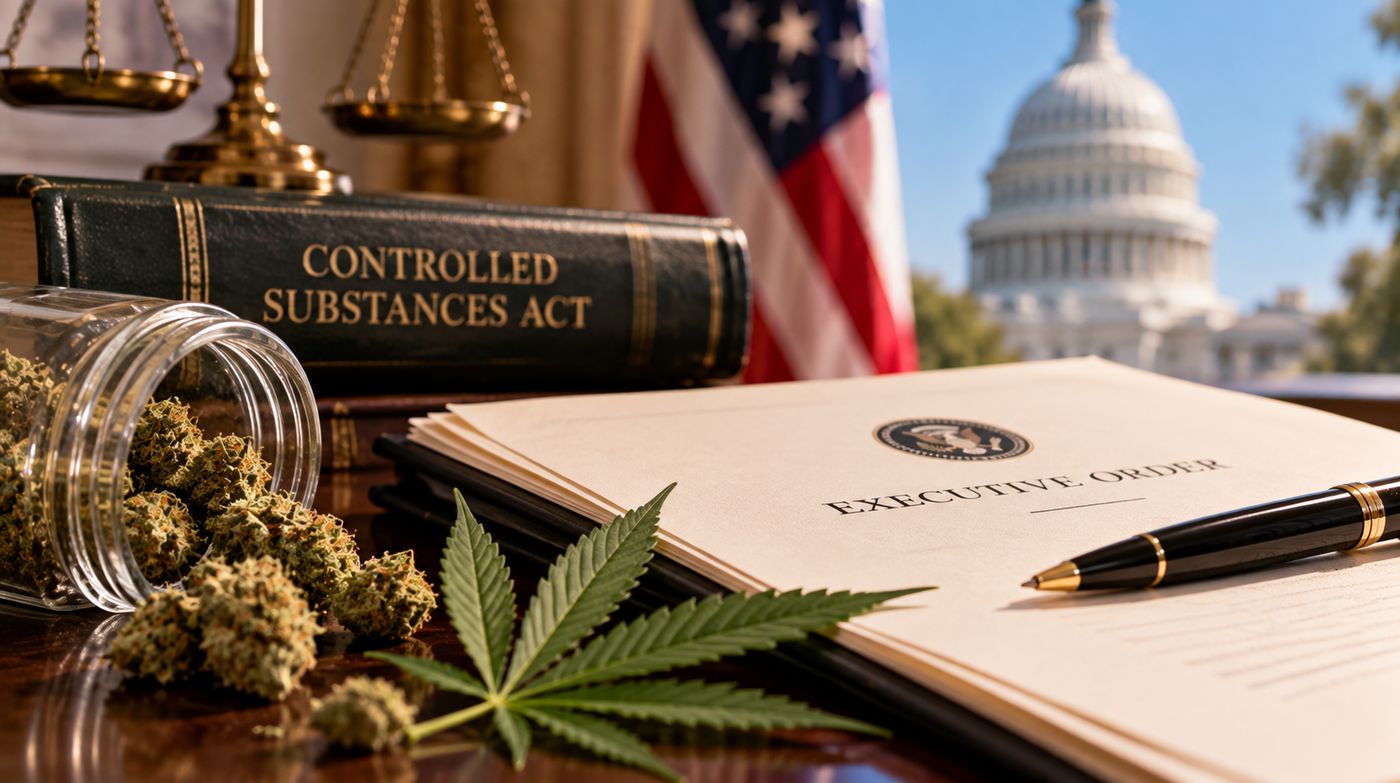
For 50 years, marijuana has sat on the same federal list as heroin and LSD. Schedule I — the most restrictive drug classification in the country, reserved for substances the government says have no accepted medical use and a high potential for abuse.
That officially changed this week.
President Trump signed an executive order directing Attorney General Pam Bondi to fast-track the reclassification of cannabis from Schedule I to Schedule III — alongside ketamine and anabolic steroids. The order marks the first time in US history that the federal government has formally acknowledged that marijuana has legitimate medical value.
For anyone who has followed the cannabis debate for the past decade, it's a genuinely significant moment. For anyone hoping this means weed is now legal everywhere, it doesn't. Here's what it actually does.
What Schedule III Actually Means
The five-tier federal drug scheduling system runs from Schedule I (most restricted, no recognized medical use) to Schedule V (least restricted). Moving cannabis from I to III is not a small step.
Schedule I status was the reason cannabis couldn't be meaningfully studied at the federal level. Researchers trying to investigate marijuana's effects — for pain, for epilepsy, for cancer patients — faced extraordinary regulatory barriers because the government said the substance they wanted to study had no medical value. The reclassification removes that barrier.
Schedule III also lowers the legal risk for cannabis businesses operating in legal states. Currently, federal law prohibits businesses dealing in Schedule I substances from deducting normal business expenses on their taxes — a rule called 280E that has cost the cannabis industry billions. Schedule III would end that, dramatically improving the financial viability of legal cannabis operations.
What It Does NOT Do
Trump said it plainly at the signing: "This order does not legalize marijuana in any way, shape or form, and in no way sanctions its use as a recreational drug."
The reclassification does not make cannabis federally legal. Recreational use remains illegal under federal law. Possession, distribution, and cultivation of cannabis outside of federally licensed medical channels would still be federal crimes — even in states that have legalized it recreationally.
What changes is the research pathway, the tax burden on legal businesses, and the official federal acknowledgment of medical value. What doesn't change is whether your state's dispensary is technically in violation of federal law. It still is.
The practical impact for most consumers in legal states will be limited. For the medical cannabis industry, for researchers, and for cannabis businesses drowning in 280E taxes, the change is substantial.
How Long Will This Actually Take
This is where expectations need to be managed. The executive order directs the Attorney General to complete the rescheduling process — but the process itself still has to happen. It involves DEA regulatory procedures, public comment periods, and federal rulemaking that can take years.
One analysis from the Congressional Research Service noted that even with an executive order pushing it forward, the formal rescheduling process could take up to nine years.
The order accelerates that process. It doesn't complete it. Marijuana is not yet Schedule III — Trump directed that it be moved there. The difference matters.
Why This Is Still a Big Deal
The symbolic weight of this moment is real regardless of the timeline. The Biden administration had begun the same rescheduling process but didn't complete it before leaving office. Trump — who campaigned on keeping drugs classified as dangerous — has now issued the most significant federal cannabis policy shift in half a century.
"Rescheduling marijuana corrects the Federal government's long delay in recognizing the medical use of marijuana," the White House fact sheet states, "and will vastly improve research on safety and efficacy."
The cannabis advocates who spent decades arguing that Schedule I classification was scientifically indefensible are now watching a Republican president agree with them — officially, in a signed executive order. The research that couldn't happen for 50 years can now move forward. The tax burden strangling legal businesses has a clear end date.
What comes next depends on how fast the regulatory process moves, whether Congress acts, and what happens in the midterm elections next month. But the federal government's position on cannabis — unchanged since 1970 — just changed.