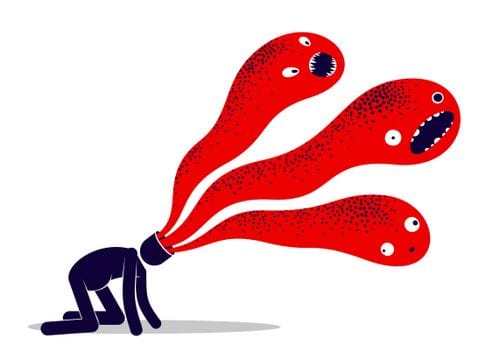
There is a growing philosophical position, most concentrated in environmental and academic circles, that goes considerably further than "we should do better." It argues that humanity is not merely behaving badly — that the problem isn't capitalism, or industrialization, or political failure — but that the human species itself is constitutively destructive. That we have been, from the very beginning, the wrong organism for this planet. And that the most honest response to this realization is to stop reproducing.
This is not a fringe view held by cranks. It has serious philosophical foundations, a dedicated global movement, and a presence in progressive discourse that has grown alongside climate anxiety for decades. Understanding it is useful — both because it explains something real about where a portion of the culture is psychologically, and because the counterarguments are more interesting than the dismissals.
Anthropocene Antihumanism
The intellectual framework was named and mapped by literary scholar Adam Kirsch in his 2023 book The Revolt Against Humanity. Kirsch identifies two distinct strands of what he calls "Anthropocene antihumanism," united by the conviction that the human era should end but arriving there by different routes.
The first strand is environmentalist: a reverence for the pre-human natural world as a kind of Eden that humanity has irreversibly corrupted. Bill McKibben's 1989 claim that nature, in any meaningful sense, no longer exists — having been so thoroughly shaped by human activity that there is no "outside" left — is a foundational text. From this position, the logical conclusion is that the planet would be better off without us, and the ethical response is to refuse to perpetuate the species.
The second strand is technofuturist: a hope that artificial intelligence or some successor organism will replace biological humanity and govern the planet more wisely. These two groups agree on very little politically but share the core conviction that Homo sapiens has had its chance and squandered it.
The Voluntary Human Extinction Movement

The most organized expression of this thinking is the Voluntary Human Extinction Movement, founded in 1991 by Les Knight, who stopped reproducing in the 1970s as a personal ethical commitment. VHEMT asks people to choose not to have children, allowing the species to phase out peacefully. Its motto: "May we live long and die out." Knight estimates tens of thousands of active supporters globally, with a much larger sympathetic audience.
As philosopher Victor Kumar has documented, this position has become surprisingly mainstream in certain progressive circles — not as formal commitment but as a felt sense that humanity has disqualified itself. The idea that Children of Men is aspirational rather than dystopian is, for some, genuine sentiment rather than dark humor.
What Actually Drives It
Climate anxiety — sustained distress from ecological awareness without corresponding agency — is documented at significant scale. A 2021 global survey of 10,000 young people aged 16 to 25, published in The Lancet Planetary Health, found that 56% believed "humanity is doomed." Anti-humanism offers a philosophical framework for that feeling — a way of making despair coherent.
The problem is that coherence and accuracy are different things. Humanity's ecological record is genuinely catastrophic. But the claim that this makes the species inherently destructive is a philosophical leap, not a scientific conclusion. Kirsch notes the uncomfortable recursion: the people making this argument are humans, the moral intuitions driving it are human achievements, and the future they're grieving is valued from within a human ethical framework.
The Buddhist Counterargument
The most useful counterweight isn't optimism but a philosophy of action under uncertainty. Joanna Macy, environmental activist and Buddhist scholar, developed "active hope" — drawn from Buddhist non-attachment to outcomes. You can act with full commitment toward a goal without requiring certainty you'll achieve it.
This is distinct from toxic positivity and from despair. It asks: what is the right action, given what we know, regardless of outcome? A surgeon operates on a patient with uncertain prognosis. The action's value isn't contingent on the result.
A Useful Idea Taken Too Far

Anti-humanism contains a genuinely important insight: the Enlightenment assumption that humans are entitled to unlimited use of planetary resources is philosophically indefensible. Acknowledging that is necessary.
Where it breaks down is the conclusion. The same species that drove mass extinction also developed germ theory, abolished slavery, and is currently engineering gene therapies for inherited diseases. Human history doesn't support a single verdict. The question of whether humanity deserves to continue is unanswerable — and probably the wrong question. What Macy poses instead is the right one: given that we're here and this is what's happening, what's the right thing to do now?