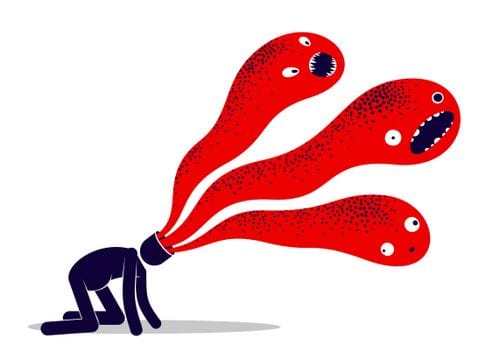
You know the one. Their texts arrive in clusters, always urgent. Every conversation is consumed by the latest catastrophe — the conflict with a coworker, the relationship in freefall, the thing that happened that you absolutely need to hear about. You find yourself braced for whatever's next. You realize, slowly, that you almost never talk about yourself. When was the last time they asked?
TikTok has a term for this dynamic: the crisis friend. The phrase was coined in a now-deleted video by user @carpoolsandcountryclubs, preserved through thousands of stitches and reactions, which described the pattern plainly: "Every day, every week, there is a new crisis that they have to have support for — they need to be emotionally rallied around, and everyone needs to get behind them."
The videos have millions of views. The comment sections reveal something more interesting than a shared complaint.
What TikTok Means by "Crisis Friend"
@elliemcmakin Btw before you get all upset there is a difference between the crisis friend im talking about and someone who manufactures crisises to one up yours. #friendship#adulthood♬ original sound - Ellie McMakin
The crisis friend is not simply a friend going through a hard time — that's an important distinction that therapists and mental health professionals are quick to make, and that USA Today's coverage of the trend emphasizes. Anyone can have a rough stretch. A crisis friend is a pattern — a persistent, structural imbalance in which one person's difficulties are always the organizing principle of the friendship.
Signs, as identified in TikTok discussions and by licensed counselors: the person knows little to nothing about your life because it's never the subject; everything is framed as happening to them; accountability for how situations developed is absent; and your own needs, problems, or good news get absorbed or redirected toward what they're currently navigating.
Christina Roig, a Licensed Professional Counselor who has spoken about the trend, describes the dynamic: "All your communication, conversations, and plans revolve around the crisis friend's problems, and your problems go unaddressed."
The crises themselves, in most documented cases, are genuine. This is what makes the pattern difficult to identify and harder to address. The friend with the bird mite infestation followed immediately by a broken leg followed immediately by COVID wasn't manufacturing drama — she was having genuinely bad luck. What distinguishes the crisis friend isn't the severity of what's happening but the constancy of their need and the one-directionality of the exchange.
The Important Distinction
The term has generated pushback from people who point out that crisis friends may be carrying mental health conditions, neurodivergence, trauma histories, or circumstances that make consistent crisis more likely. The TikTok framing — which often implies a simple, judgment-based decision to cut contact — can be too blunt an instrument for what are frequently more complicated situations.
Roig addresses this directly: "Some clients I see who take on this role know that they are engaging in it, but struggle with stopping. Through therapy, we can work to reduce these behaviors by finding a different way the person can have these needs met. The goal is to make relationships more balanced and safe."
The framework that distinguishes the crisis friend from the friend in crisis: Is the dynamic changeable? Is there awareness on the person's part that the friendship is one-sided? Is there a desire to address it, even if the tools aren't yet available?
The Harder Question

Here is the part of the crisis friend conversation that makes comment sections more complicated than the original thesis: "A hallmark of a true crisis friend, I think, is that they have no idea they are the crisis friend."
The original TikTok framing was about recognizing the pattern in others. What spread through the comment sections, and what has made the trend durable rather than disposable, is the second realization — the quiet "uh oh" of someone reading the description and recognizing, with some discomfort, that there have been periods of their own life where they fit it.
Most people have been both. Most people who've gone through a genuinely difficult stretch have leaned heavily on someone whose patience eventually ran thin. The more honest version of the crisis friend conversation isn't "do you have one?" It's "what do you do when you realize you've become one — and what does a friendship look like when someone is recovering from being one?"
What Experts Say About What to Do
The practical guidance from therapists runs consistently in one direction: before cutting contact with someone you've identified as a crisis friend, try addressing it directly. Naming the dynamic — not as an accusation but as an observation — opens the possibility of change that cutting contact forecloses.
"Setting limits helps everyone involved have happier and healthier relationships," Roig says. "Limits are not rules people have to follow; they are expectations you have for people you are in a relationship with." For many people, the crisis friend doesn't need to end — it needs recalibration.
For the person who has realized they might be the crisis friend: the awareness itself is the beginning of the recalibration. It is not a character verdict. It is a pattern, and patterns can change.